
Construction Update
Construction has begun on Stellar Vista Observatory’s phase 1 facilities at Jackson Flat Reservoir! Here’s a photo taken on September 20, 2026 showing the early stages of road building, excavation and soil compaction at the site.

Event Round Up
International Observe the Moon Night on September 19th was a hit! About 40 people attended our free public star party at Coral Pink Sand Dunes State Park. An eager contingent showed up early to get started! The moon took center stage as viewers got to see craters, Lunar Maria and other features. Michael McKeon was present with his telescope as were Eric and Sylvia Sims and Mislav Kos from SVO, who also brought their telescopes. On the same night SVO president Rich Csenge hosted 16 guests for the occasion at the exclusive Amangiri Resort in Big Water, Utah.
Join Us for the Next Curious Cosmos Lecture About the Crab Pulsar
Our next Curious Cosmos Lecture will take place on October 21st at 6pm in the Multipurpose Room at the Kanab City Library. The lecturer, Colin Littlefield, is a member of SVO’s Advisory Committee. Colin is an astronomer at the Bay Area Environmental Research Institute and a member of a speckle interferometry research group based at the NASA Ames Research Center.
Historical records from July 1054 report an extraordinary event in the sky: the sudden appearance of a new star so bright that it was visible in broad daylight. The astronomers of the time didn’t know it, but they had witnessed a supernova that marked the death of a massive star and the birth of the famous Crab Nebula, now a popular target for amateur astronomers. At the heart of the Crab Nebula is one of the most exotic objects in the entire sky: the Crab Pulsar.
More massive than the Sun but only the size of a city, the Crab Pulsar is the ultra-dense remnant of the core of the star that exploded in 1054, with a surface gravity over 100 billion times stronger than at Earth’s surface. A cosmic lighthouse, the pulsar spins 30 times per second, producing a bright flash with every single rotation. The Crab Pulsar’s many extremes — from its dizzying rotation to its crushing surface gravity to its incessant strobe-like flashes — make it one of the most fascinating objects in astronomy and a benchmark for understanding the fate of massive stars.
Please join us for this fascinating lecture that brings together history and astronomy.

Photo of the Month
This month’s featured photo was taken by Eric Sims, SVO.
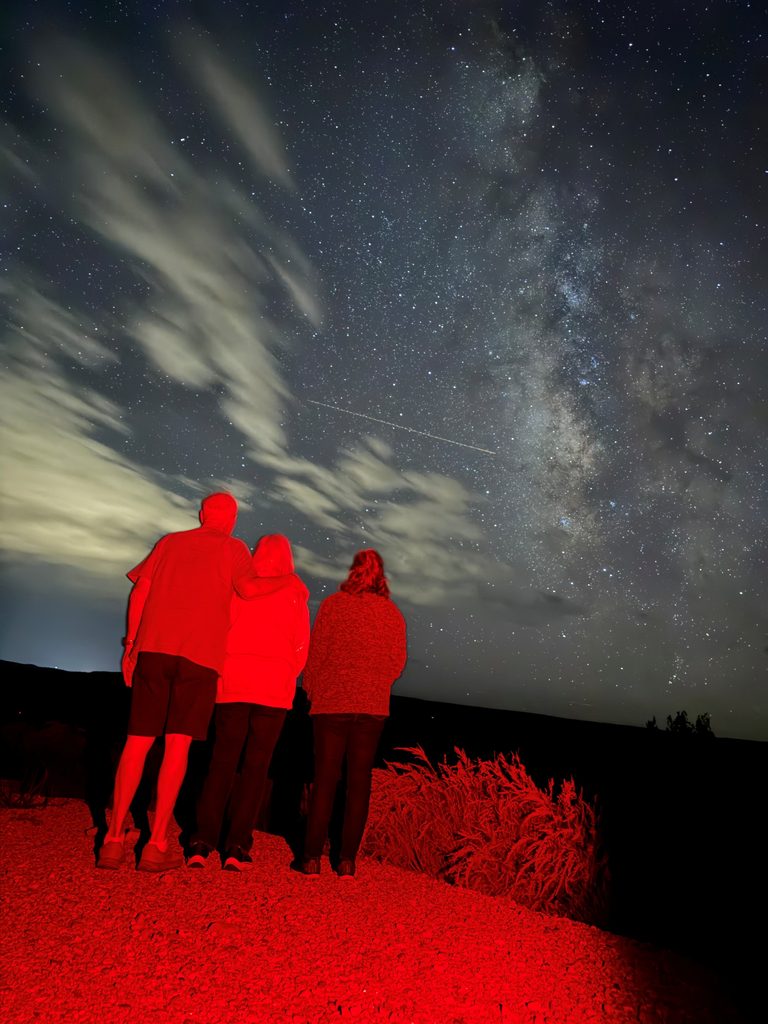
A group of guests are enjoying their view of our Milky Way Galaxy. Eric says he Ioves taking guest photos with the Milky Way during the summer and early fall, as it is often their favorite photo from the trip. For more information about booking one of our private night sky experiences, please visit: Private Night Sky Experiences | Stellar Vista Observatory.
If you have a night sky photo that you would like to share with our audience, we would love to include it in our monthly newsletter. Please send your photos to info@stellarvistaobservatory along with your name and a caption describing key objects featured in your image.
What Asteroids Teach Us About Life on Earth
by Ella Elman, SVO
In the past few years, scientists have been able to bring back samples of material from two asteroids to see what they are made of. The first mission was to Ryugu, located approximately 300 million kilometers away and launched by the Japan Aerospace Exploration Agency. The mission was launched in 2014 and used an uncrewed spacecraft that landed on the asteroid in 2019. The spacecraft collected two dust samples from the asteroid’s surface and returned them to Earth in 2020.
The second mission targeted asteroid Bennu, which passes close to earth every six years. NASA’s OSIRIS‑REx mission returned samples to Earth on 24 September 2023. Both asteroids represent a common type of asteroid known as carbonaceous asteroids, which make up 75% of all asteroids in our solar system.
Detailed analysis of both asteroid samples took years, and a surprising study was published in March of 2026, revealing that both asteroids contain the building blocks of life as we know it on Earth. The asteroids contain complex organic compounds, amino acids, bio‑essential sugars, phosphate-bearing molecules, and all five canonical nucleobases, which form the molecular ingredients of DNA and RNA. This is an astounding finding about rocks that are floating about in space.
Laboratory analysis showed that both asteroids contain all five canonical nucleobases used in DNA and RNA. This unprecedented discovery shows that the full suite of genetic building blocks existed in the early solar system long before life emerged on Earth. Further studies found that Ryugu’s material includes approximately 20,000 soluble organic compounds, fifteen amino acids, and presolar grains (dust older than the Sun itself).
Analysis of Bennu shows that in addition to all five nucleobases, it also contains bio‑essential sugars, including ribose, a critical component of RNA as well as phosphate-bearing compounds, another key ingredient of nucleotides. Together, these represent two of the three main structural components of an RNA nucleotide, suggesting that Bennu carried a remarkably complete molecular toolkit for prebiotic chemistry.
Beyond individual molecules, researchers have identified polymeric organic materials in samples from primitive asteroids like Bennu. These complex macromolecules may have played roles in early chemical evolution, acting as scaffolds or reaction surfaces that helped simple molecules assemble into more complex ones.
What does this all mean? While there is no indication of life on either Bennu or Ryugu, we now know that life’s molecular precursors were widespread in the early solar system. It is likely that early Earth received repeated deliveries of organic-rich material and that asteroids and meteors may have seeded the planet with the raw ingredients for life.
We are now learning that prebiotic chemistry is a natural outcome of solar system formation, not a rare accident. One potential mechanism for how this occurs has to do with the discovery that there is a correlation between the purine-pyrimidine ratio and the concentrations of ammonia on the asteroids. Purines and pyrimidines are the two families of nitrogen‑containing bases that make up the “letters” of DNA and RNA. It is possible that ammonia may have been a key factor driving nucleobase formation pathways in the asteroids’ distinct environments, which is a revolutionary new finding.
As scientists continue analyzing these pristine samples, they’re uncovering a molecular archive that predates Earth itself. The discoveries from Ryugu and Bennu reshape our understanding of how life might begin not only on Earth, but anywhere rocky worlds encounter carbon-rich asteroids.

Free Public Star Parties and Events
Please join us for free star parties and events this fall and winter!
- Friday, October 2, 2026 – Jacob Hamblin Park. 8:15 pm. Grand Circle Trailfest: Stargazing in the park – come see the Summer Triangle, Saturn, Neptune, the Milky Way, double stars and more!
- Wednesday, October 21, 2026 – Multipurpose Room at the Kanab City Library. 6:00 pm. Our next Curious Cosmos Lecture will feature Astronomer Colin Littlefield discussing the Crab Pulsar.
- Friday, November 6, 2026 – Jackson Flat Reservoir Boat Launch Parking Area. 7:00 pm. Saturn, Neptune, the Perseus Double Cluster, our Milky Way and the Andromeda Galaxy will all be on display along with Taurid meteors!
- Sunday, Dec 13, 2026 – Jackson Flat Reservoir Boat Launch Parking Area. 7:00 pm. The peak of the Geminids meteor shower, the Pleiades star cluster, and Orion returns to the evening sky.
Our events calendar can be seen at: Public Star Parties | Stellar Vista Observatory.